Commercial Carpet Considerations for Healthcare Facilities
Healthcare flooring affects far more than the appearance of a medical building. In hospitals, clinics, medical offices, and rehabilitation facilities, the flooring choice influences cleaning routines, circulation, staff workflow, patient comfort, and long-term maintenance planning. Hospital flooring must be selected by application area, not as one universal solution for the entire building. Where carpet is appropriate, commercial carpet tiles can give procurement teams a modular option to compare alongside other flooring materials. This guide explains the questions B2B buyers should ask when assessing commercial carpet for healthcare projects in Southeast Asia.
Healthcare Flooring Guide Contents
- Healthcare flooring requirements by area
- Commercial carpet tiles and other flooring options
- Fiber, high-traffic performance, cleaning, and specifications
- Supplier questions, project support, and FAQs
What Makes Healthcare Flooring Different?
Healthcare buildings combine public circulation, patient-facing areas, staff spaces, and technical functions. Many areas experience continuous foot traffic, frequent cleaning, wheelchairs and equipment movement, and changing traffic patterns throughout the day. A suitable flooring plan should also consider patient comfort, staff workflow, noise, access for maintenance equipment, and future replacement. Different areas can need different flooring solutions, and not every healthcare space is appropriate for carpet. Procurement teams should confirm project requirements and applicable local rules with the responsible project professionals before approving a product.
Healthcare Flooring: Key Factors When Choosing Carpet
- Cleaning requirements: Review daily routines, spot-cleaning expectations, spill exposure, and the equipment used by facility teams.
- Traffic level: Map public routes, reception areas, corridors, waiting rooms, and staff circulation rather than applying one specification everywhere.
- Comfort and acoustics: Consider the desired underfoot feel and the contribution flooring can make to a quieter interior.
- Appearance and maintenance: Assess how pattern, color, construction, and replacement planning support the operating environment.
- Installation: Review subfloor conditions, access, backing, installation method, and the plan for future repairs.
Do not select a healthcare carpet only by color or price. The useful comparison is the complete product construction and how it fits the intended space, cleaning plan, traffic, and project documentation. A commercial carpet specification sheet gives buyers a clearer basis for comparing quotations and samples.
Healthcare Flooring Areas That May Use Commercial Carpet
Patient Rooms
Where carpet is appropriate for the room function, buyers may consider comfort, a quieter atmosphere, interior appearance, and a maintenance approach that fits the facility’s operations. Product suitability must be confirmed for the specific project area.
Corridors
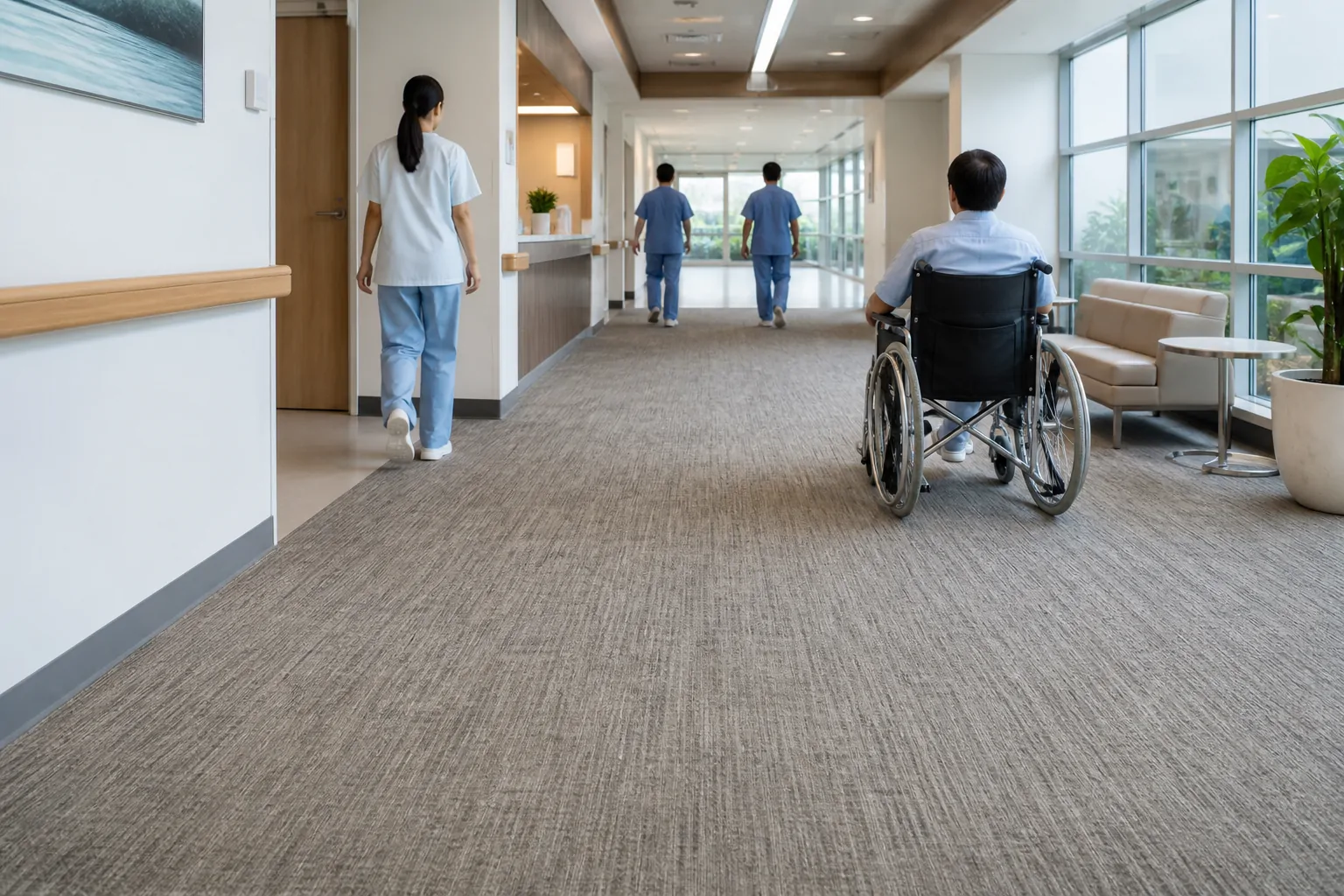
Corridors need careful evaluation because of high traffic, wheelchairs, equipment movement, cleaning frequency, and visible circulation paths. Fiber, pile construction, backing, and installation all influence the practical performance of a high traffic carpet choice.
Waiting Areas
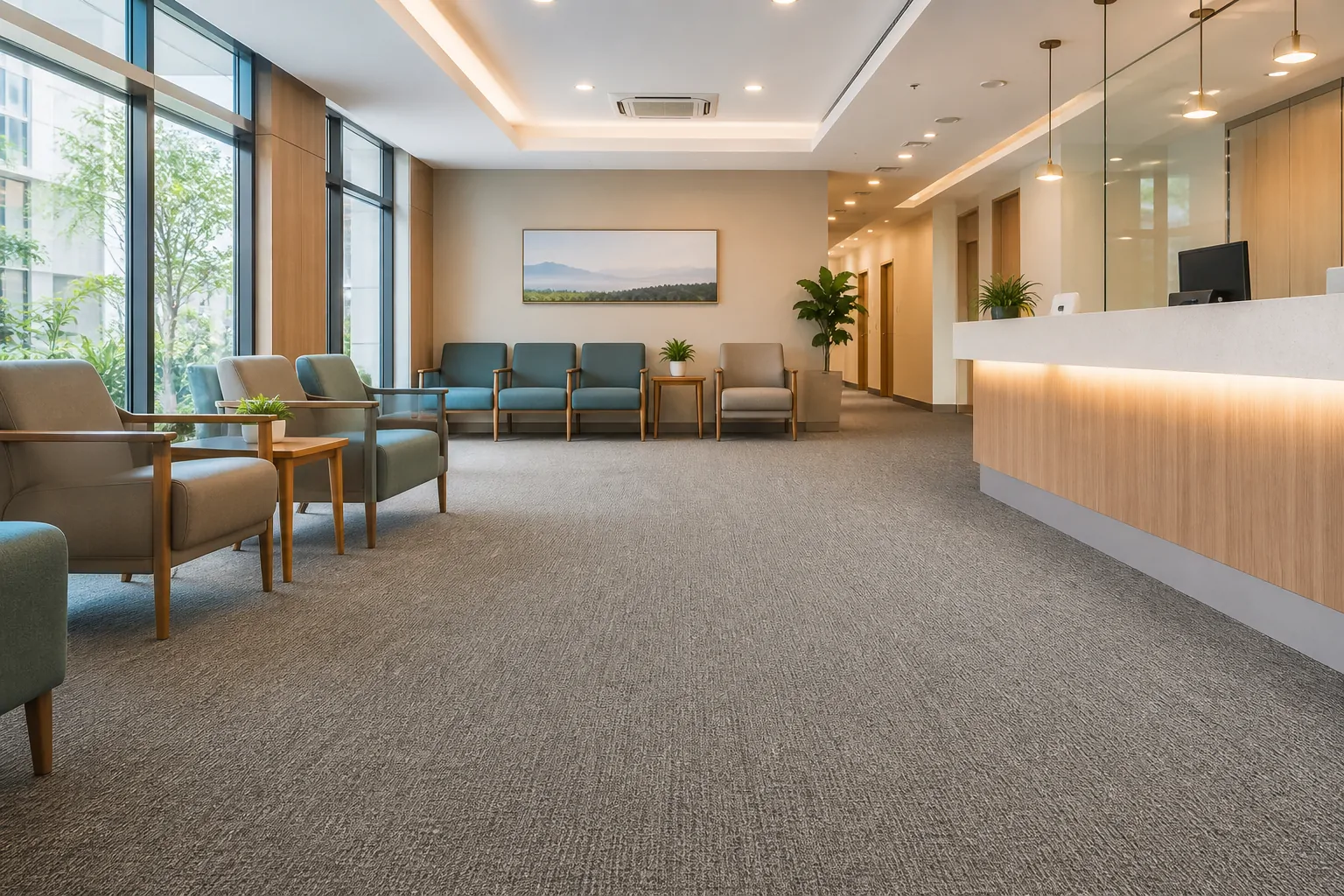
Waiting areas combine visitor traffic, first impressions, comfort, and coordination with the wider interior design. A commercial carpet option can be compared where its maintenance and operational fit are appropriate.
Medical Offices and Administration Areas
Medical office flooring and administration areas often require a professional appearance, manageable maintenance, long-term durability, and acoustic comfort similar to office environments. Their traffic conditions may differ substantially from public healthcare routes.
Carpet Tiles vs Other Healthcare Flooring Options
| Factor | Carpet Tiles | Other Flooring Options |
|---|---|---|
| Local replacement | Individual modules can support targeted replacement planning | Repair approach depends on the material and installed system |
| Design flexibility | Modular colors, patterns, and zoning layouts are possible | Available design choices vary by flooring type |
| Comfort | Can provide a softer underfoot surface where appropriate | Comfort differs by material and system |
| Acoustic environment | Can contribute to a softer-feeling interior | Result depends on the chosen material and construction |
| Maintenance planning | Spare tiles can be planned for future local replacement | Maintenance approach depends on the flooring system |
| Installation | Requires substrate preparation and module layout control | Installation requirements vary by product |
| Suitable areas | Only areas confirmed suitable for the project requirements | Depends on the area function and project requirements |
The value of commercial carpet tiles often comes from modular replacement, handling convenience, and design flexibility. That does not make carpet tiles the right answer for every healthcare area. Compare the area function, cleaning method, traffic, project requirements, and approval process before choosing between carpet tiles and other healthcare flooring options.
Why Carpet Tiles Are Considered for Healthcare Projects
Healthcare carpet tiles may be considered for appropriate spaces because a damaged module can be addressed without replacing an entire broad area. Their modular format can support replacement-stock planning, flexible pattern layouts, zoning by department or circulation route, and more manageable transport and handling. Backing choice matters as much as the tile face: see carpet tile backing types when comparing options. Product selection should still follow the healthcare project’s documented requirements and local approval process.

Choosing Carpet Fiber for Healthcare Applications
Nylon, polypropylene or olefin, and solution-dyed options can each be evaluated for a healthcare application. Nylon is commonly reviewed for resilience, traffic areas, and appearance retention. Polypropylene can be reviewed against cleaning considerations, product construction, and budget factors. Solution-dyed options may be considered where color consistency and maintenance are priorities. None of these fiber groups is automatically the best choice. The final decision should combine the product construction, traffic level, cleaning plan, backing, and project requirements. For a fiber comparison, read nylon vs polypropylene commercial carpet.
High Traffic Areas and Healthcare Carpet Selection
Hospital corridors, reception areas, waiting rooms, and public circulation zones can place repeated demands on a flooring system. When a high traffic carpet is being considered, review fiber, density, face weight, pile height, backing, and installation quality together. Greater thickness or weight does not automatically mean a product is more suitable for a healthcare project. Buyers should define likely wheel routes, equipment movement, entrance dirt exposure, cleaning routines, and appearance expectations before comparing products.
Specification figures are useful only when they are interpreted together. Review the commercial carpet pile height, density and weight guide before aligning samples, quotations, and installation planning.
Cleaning and Maintenance Considerations
Maintenance planning should start before ordering. Discuss daily cleaning routines, spot-cleaning procedures, traffic patterns, entrance dirt control, access for equipment, and who will manage replacement materials. For carpet tiles, approved spare modules can simplify a later local replacement plan. For other commercial carpet formats, spare material and batch consistency should be planned early. A clear cleaning and maintenance process helps facility managers protect the intended appearance of healthcare flooring over time.
Healthcare Carpet Design Considerations
Healthcare carpet design should serve operations as well as appearance. Pattern and color can support department zoning, wayfinding, visual rhythm, and coordination with walls, furniture, and lighting. A hospital carpet that hides everyday traffic marks may be helpful in the right area, but colors and patterns must also support the overall interior and maintenance plan. Custom colors and patterns should be reviewed with physical samples and an area plan rather than approved from a digital image alone.
Specifications Buyers Should Check
- Fiber type and carpet construction
- Pile height, face weight, density, and total thickness
- Backing type and tile size where relevant
- Installation method and subfloor requirements
- Available product documents and physical samples
- Cleaning and maintenance guidance
- Replacement stock and export packing plan
There is no universal fixed specification for flooring for healthcare facilities. Ask the supplier to explain how the proposed construction relates to the documented application area and operating conditions.
Common Mistakes When Selecting Healthcare Carpet
- Choosing only by appearance.
- Comparing only price.
- Ignoring traffic levels and wheel routes.
- Ignoring cleaning requirements.
- Selecting unsuitable backing for the installation plan.
- Not checking physical samples.
- Not planning replacement materials.
- Assuming one product fits every healthcare area.
Questions to Ask a Healthcare Carpet Supplier
- Is this product suitable for the specified healthcare application area?
- What fiber and backing options are available?
- What are the pile height, face weight, density, and total thickness specifications?
- Is the proposed product suitable for the expected traffic?
- What maintenance is recommended?
- Are physical samples and available product documents provided?
- Can colors and patterns be customized?
- What are the MOQ, production lead time, and export packing options?
How Melozon Supports Healthcare Carpet Projects
Melozon can support healthcare flooring discussions with commercial carpet selection, carpet tile solutions, fiber and backing comparisons, product specification communication, custom colors and patterns, standard and custom samples, OEM or ODM conversations, bulk project quotations, and export packing and shipping support. Explore commercial carpet products to begin comparing suitable formats for your project.
Request Healthcare Carpet Samples and Project Support
Send Melozon your healthcare project type, application area, estimated quantity, and design requirements to discuss suitable commercial carpet solutions and request samples. Request samples and project support.
Healthcare Flooring FAQ
What type of flooring is best for healthcare facilities?
The appropriate flooring depends on each area’s function, traffic, cleaning needs, project requirements, and applicable approvals. One product is not automatically right for every healthcare space.
Can carpet tiles be used in hospitals?
Carpet tiles may be considered for areas where their use is suitable for the project’s requirements. Confirm the specific area, product documentation, and approval process before selection.
What should be considered when choosing hospital flooring?
Consider traffic, equipment movement, cleaning, comfort, maintenance, installation, and the function of the specific hospital area.
Is carpet suitable for medical offices?
Carpet can be considered for medical office flooring where it matches the area function, maintenance plan, and project requirements.
What is healthcare carpet?
Healthcare carpet refers to commercial carpet considered for suitable healthcare project areas, assessed against traffic, cleaning, construction, and documented project requirements.
Are commercial carpet tiles suitable for clinics?
They can be considered for clinic areas when the product and installation approach fit the intended use and project requirements.
How do I choose flooring for healthcare facilities?
Start with an area-by-area map of traffic, cleaning, comfort, equipment routes, and maintenance, then compare complete product specifications and samples.
What carpet is suitable for high traffic healthcare areas?
Compare fiber, construction, pile height, density, backing, installation, cleaning, and the expected traffic route rather than relying on one figure.
Can healthcare carpet be customized?
Custom project discussions can include color, pattern, samples, and specification communication for suitable commercial carpet applications.
Should healthcare buyers request samples before ordering?
Yes. Physical samples help project teams review texture, color, construction, pattern direction, and suitability alongside the relevant project requirements.