
How to Compare Commercial Carpet Supplier Quotations
A commercial carpet quote is more than a price per square metre. For hotels, offices, schools, healthcare spaces, and mixed-use developments, the quote should show exactly what will be supplied, how much material is required, how it will be packed and shipped, and which project costs are included. Two offers can look similar at first and still produce very different landed costs or installation risks.
This guide explains how buyers, contractors, designers, and distributors can compare a commercial carpet price and quote requirements before selecting a supplier. The goal is a like-for-like comparison that protects the project budget while keeping specifications, delivery, and quality requirements clear.

Why Commercial Carpet Quotes Are Difficult to Compare
Suppliers do not always define ??rice??in the same way. One commercial carpet supplier may quote material only, while another may include packaging, export documents, inspection, or delivery to a named destination. One may calculate the required quantity from net floor area; another may add cutting waste, reserve stock, or carton constraints. Comparing the headline number without comparing the assumptions creates a false saving.
The product description can also hide important differences. A carpet tile with a similar colour may have a different fibre, pile construction, backing, size, or performance rating. Before comparing price, create a common specification sheet and ask every supplier to respond to the same project information.
Compare the Product Specifications First
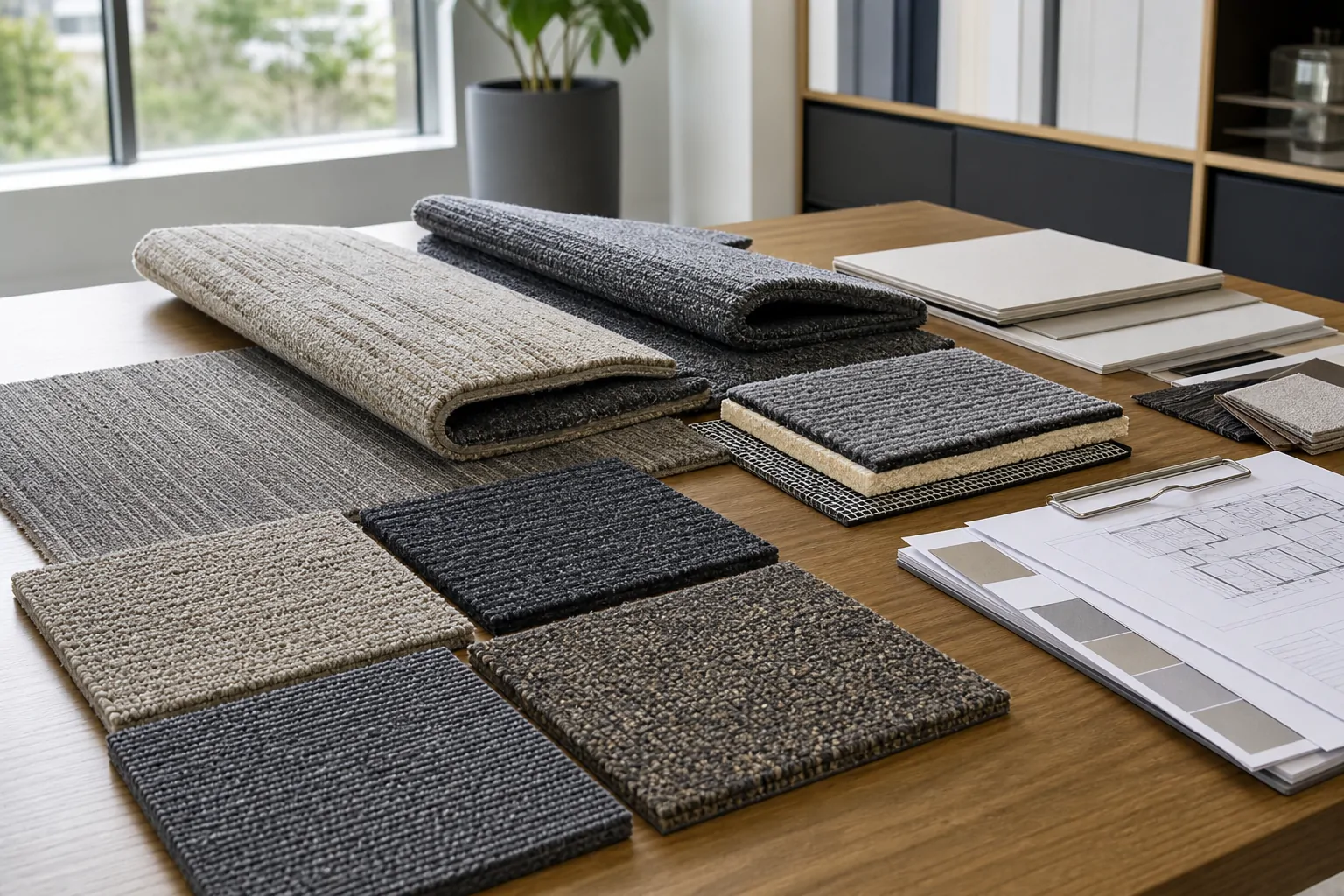
Start with the specification, because a lower price is not useful if the product cannot meet the design or operating conditions. Compare the following fields line by line:
- Product format, such as carpet tile, broadloom, runner, or a custom shape.
- Finished size, pattern repeat, colour reference, and surface appearance.
- Fibre type, pile construction, pile height, total thickness, and total weight.
- Backing construction, dimensional stability, moisture considerations, and installation compatibility.
- Performance requirements for traffic, castor chairs, stairs, acoustics, fire, or other project conditions.
- Available sample, colour approval, dye-lot control, and replacement expectations.
For a product-led comparison, see Melozon?? range of commercial carpet tiles. When the design needs a special colour, pattern, or construction, also review the options for custom and bespoke carpet. The quotation should identify any approved sample or technical reference used as the production standard.
Check How the Quantity Was Calculated
Ask each supplier to show the quantity calculation. Confirm the measured floor area, installation direction, cutting pattern, roll or tile dimensions, carton quantity, and allowance for waste. For carpet tiles, the layout and orientation can affect the number of tiles required. For broadloom, seams, room geometry, and roll width may have a larger effect.
The comparison should distinguish net coverage from ordered quantity. Record the quantity in the supplier?? selling unit and the equivalent coverage in square metres. If a quote includes spare or replacement material, list it separately rather than assuming that the extra quantity is production waste.
Compare Unit Price and Total Project Cost
Once specifications and quantity are aligned, compare the complete commercial carpet cost. Use a simple table that separates included, excluded, and optional items:
| Cost Item | Supplier A | Supplier B | Questions to Ask |
|---|---|---|---|
| Product price | What unit and quantity does the price cover? | ||
| Sample cost | Is the sample charge refundable or credited? | ||
| Custom design | Are artwork, development, or tooling charges included? | ||
| Packaging and labels | Are export cartons, pallets, and project labels included? | ||
| Shipping and documents | Which freight, insurance, and export documents are included? | ||
| Inspection and bank charges | Who pays inspection, transfer, and intermediary bank fees? | ||
| Spare or replacement material | Is reserve stock priced separately and how is it packed? |
Do not invent a missing value. Mark it as ??ot stated??and request a written clarification. A reliable quote is one where the buyer can calculate the expected project total without guessing.
Review MOQ and Item Breakdown
Minimum order quantity can apply to the total project, one colour, one pattern, one size, or one production batch. Ask whether different colours or designs can be combined to reach the MOQ. Confirm whether the supplier?? calculation rounds up to full cartons, rolls, or pallets.
Separate the bill of materials into item, colour, size, quantity, unit, and spare quantity. This makes it easier to identify an apparently low price that depends on ordering more than the project needs. For a focused review, read about commercial carpet MOQ, samples and lead times.
Compare Samples and Approval Requirements
A sample should support a production decision, not only a colour decision. Confirm the sample size, construction, backing, edge finish, texture, and whether it represents the final production method. For custom work, ask how artwork, colour matching, strike-offs, and approval records are handled.
Record who approves the sample and what happens if the delivered material does not match the approved reference. This is especially important when several production lots or delivery phases are involved.
Compare Production and Delivery Schedules
A delivery date should have a clear starting point. Ask whether lead time begins after deposit, technical approval, colour approval, artwork approval, or final quantity confirmation. Separate sample development, production, inspection, booking, transit, and destination clearance.
Also ask how the supplier manages a phased project. Can later batches maintain the approved colour and construction? Is partial shipment possible? A realistic schedule should identify dependencies instead of presenting one unsupported delivery promise.
Check Shipping Terms and Destination Costs
Compare the named Incoterm, loading point, destination, shipment mode, and responsibility for insurance and clearance. A factory price and a delivered project cost are different figures. For Southeast Asia projects, compare port, inland delivery, customs, storage, and handling assumptions at the destination.
For more regional sourcing considerations, see this guide to choosing a commercial carpet supplier for Southeast Asia projects. The right comparison keeps supplier-controlled costs separate from destination charges that the buyer or contractor must arrange.
Compare Packaging and Labeling
Packaging affects damage risk, warehouse handling, and installation speed. Ask for the package type, carton or roll dimensions, gross weight, pallet method, moisture protection, and stacking limits. Confirm whether labels show project name, area, room, colour, lot, quantity, and installation sequence.
If several buildings or floors are shipped together, project-specific labels can reduce sorting work on site. Include this requirement in the quote instead of adding it after production has started.
Check Documents and Quality Requirements
List the documents required by the buyer, contractor, destination, or project consultant. Depending on the project, this may include a commercial invoice, packing list, certificate of origin, inspection record, technical data sheet, test report, or installation guidance. The supplier should confirm which documents are standard and which require additional coordination.
Quality control should be specific. Agree on the approved sample, inspection point, acceptable variation, packaging inspection, quantity check, and process for reporting a problem. Do not add certifications or test results to a comparison unless the supplier has provided evidence applicable to the quoted product.
Compare Payment Terms and Quotation Validity
Compare deposit, balance, payment method, bank charges, and the event that releases production or shipment. Check the quotation validity period and ask what may change after it expires, including raw materials, freight, currency, or custom development costs.
A quote should state whether taxes, duties, local delivery, and inspection are included. Keep commercial terms beside the technical comparison so the selected offer is practical to purchase, not only attractive on paper.
Commercial Carpet Quote Comparison Checklist
Use the following checklist when reviewing two or more offers:
| Comparison Item | Supplier A | Supplier B | Supplier C |
|---|---|---|---|
| Product format, size, colour, and construction | |||
| Fibre, backing, thickness, weight, and performance | |||
| Net area, ordered quantity, waste, and spare stock | |||
| MOQ and item or colour breakdown | |||
| Sample, artwork, and approval requirements | |||
| Production, inspection, and delivery schedule | |||
| Unit price and complete project cost | |||
| Incoterm, freight, insurance, and destination costs | |||
| Packaging, palletization, and project labels | |||
| Documents, quality checks, and issue resolution | |||
| Payment terms, validity, and change conditions |

Common Mistakes When Comparing Carpet Suppliers
- Comparing different products as though they were identical.
- Using net floor area instead of the actual ordered quantity.
- Ignoring cutting waste, seams, carton rounding, or reserve stock.
- Comparing factory price with another supplier?? delivered price.
- Leaving packaging, labels, and project sorting undefined.
- Accepting a delivery date without checking its starting point.
- Approving a colour sample without checking construction and backing.
- Assuming certificates, test reports, or documents are included.
- Overlooking MOQ by colour, size, pattern, or production batch.
- Selecting the lowest unit price before calculating total project cost.
Questions to Ask Before Selecting a Supplier
- Can you reissue the offer using our exact specification and quantity breakdown?
- Which costs are excluded from the quoted product price?
- What sample or approval reference will control production?
- How do you calculate waste, spare material, cartons, rolls, or pallets?
- What are the MOQ conditions for each colour or custom item?
- What documents and quality checks are included?
- What information do you need to confirm a firm production schedule?
- Can packaging and labels be adapted to our project and destination?
How Melozon Supports Quote Comparison
Melozon supports commercial buyers by organizing product, custom design, quantity, packaging, and export requirements around the project rather than presenting an isolated unit price. Buyers can review the commercial carpet product range, explore commercial carpet solutions, and provide the information needed for a comparable offer.
To reduce clarification cycles, prepare the project location, floor area, layout or drawings, preferred format, colour direction, performance requirements, delivery destination, target schedule, and packaging or labeling needs. Then request a comparable commercial carpet quote that sets out specifications, quantity assumptions, commercial terms, and delivery scope in one place.
Frequently Asked Questions
What should a commercial carpet quote include?
It should identify the product specification, quantity, unit price, total material cost, packaging, delivery terms, payment terms, validity, and any excluded or optional charges.
How do I compare carpet supplier prices fairly?
Use the same product specification, quantity basis, Incoterm, destination, packaging requirement, and document list for every supplier before comparing totals.
Why can two commercial carpet quotes have different quantities?
Suppliers may use different floor measurements, waste allowances, roll or tile dimensions, carton rounding rules, or spare-stock assumptions.
Should samples be included in a commercial carpet quote?
Ask whether samples, courier fees, artwork, colour matching, and development charges are included, refundable, or quoted separately.
What is the difference between factory price and landed cost?
Factory price covers the defined supplier scope. Landed cost adds relevant freight, insurance, clearance, duties, local delivery, handling, and other destination charges.
How can I avoid hidden costs in a carpet quotation?
Ask the supplier to mark every included, excluded, optional, and destination-controlled cost, then request written clarification for every blank line.
What information does a supplier need for an accurate quote?
Provide product format, area or drawings, colour and design direction, performance needs, quantity breakdown, destination, schedule, packaging, labels, and document requirements.
When should I request a revised commercial carpet quote?
Request a revision whenever the approved sample, quantity, delivery destination, packaging, schedule, or commercial terms change.