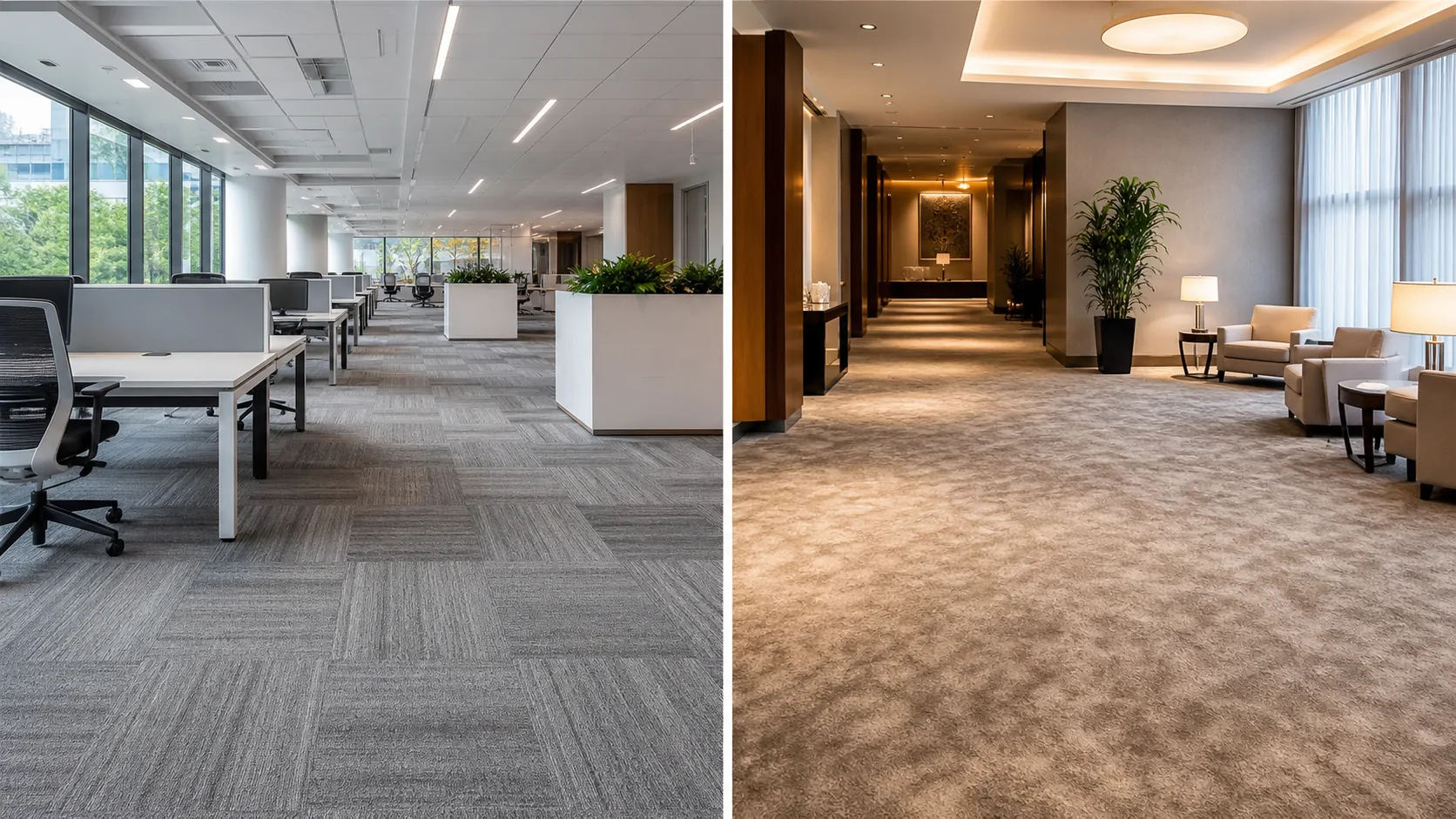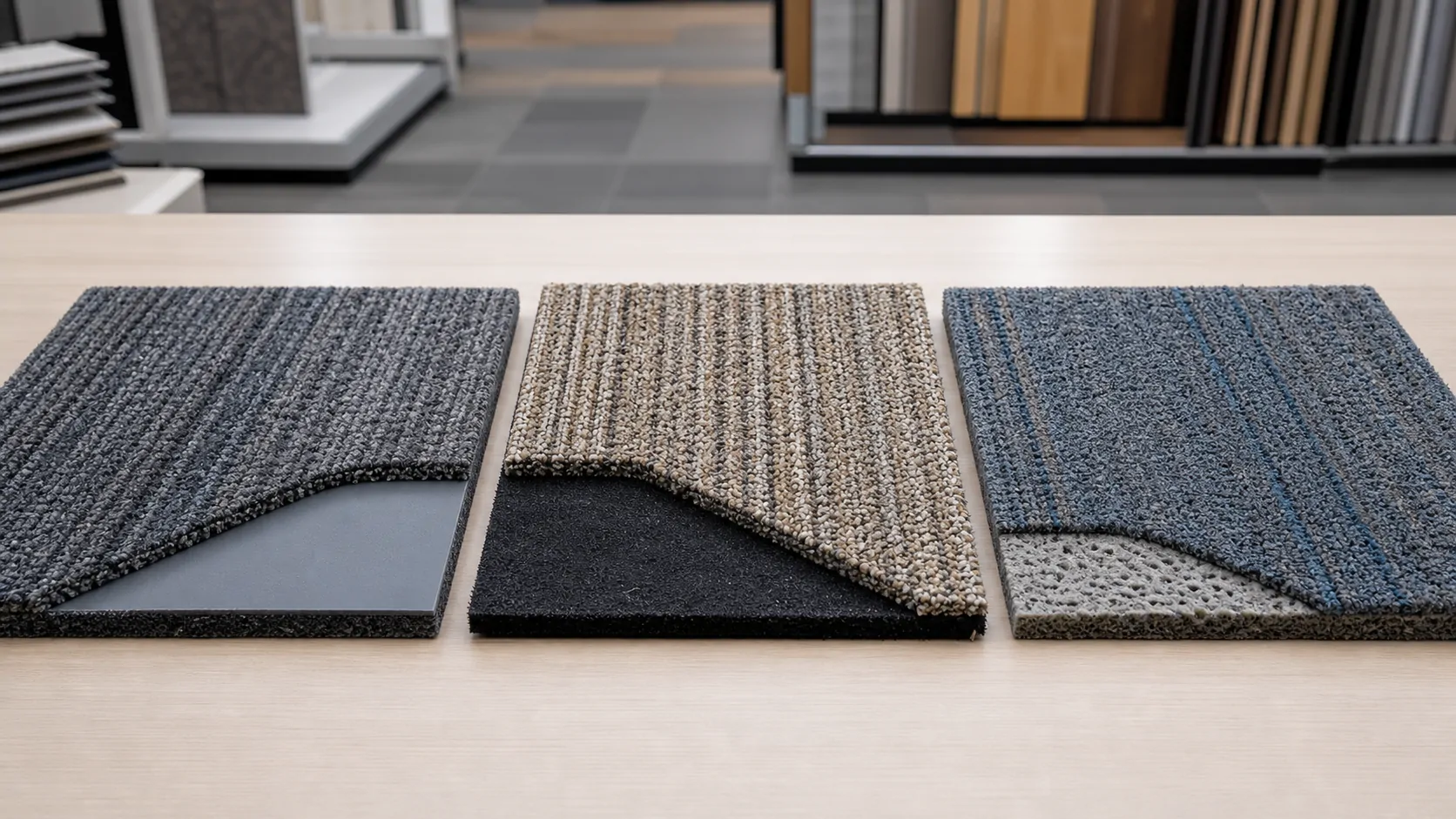
Nylon vs Polypropylene Carpet for Commercial Spaces: Which Is Better?
Choosing between nylon vs polypropylene carpet is a specification decision, not simply a choice between two colors. In commercial spaces, fiber type affects resilience, stain response, appearance retention, cleaning, and total project planning. A commercial carpet supplier can help buyers compare the full construction before a purchase is approved.
This nylon vs polypropylene carpet comparison covers two common commercial carpet tile materials. Neither material is automatically better for every office, hotel, school, healthcare area, or public building. The right choice depends on traffic, maintenance, moisture exposure, design requirements, backing, installation, and the replacement plan.
What Is Nylon Commercial Carpet?
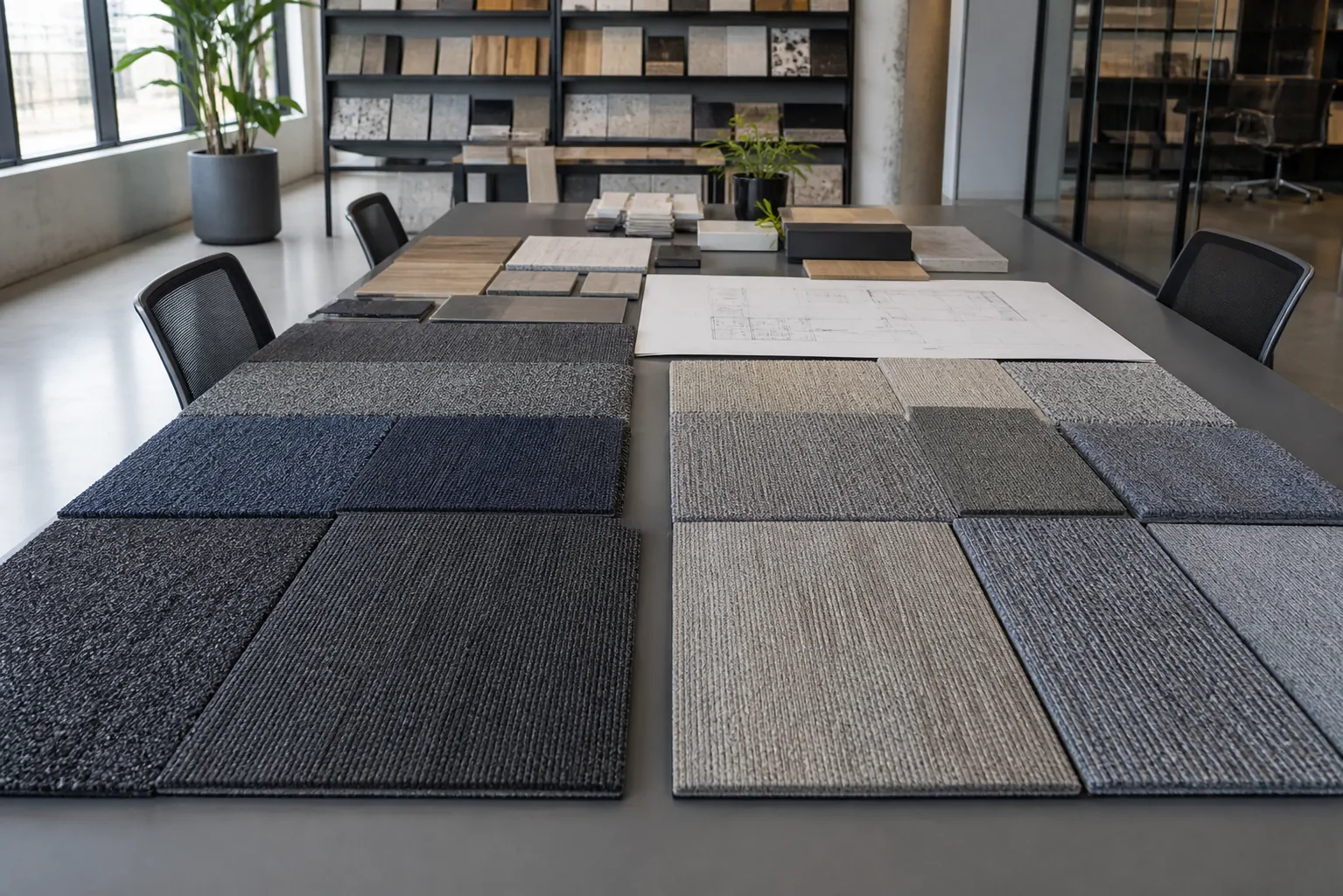
Nylon is a synthetic fiber often selected for busy commercial interiors because it can recover from repeated compression. This resilience can help a carpet surface maintain a more consistent appearance under foot traffic, rolling chairs, and furniture movement. However, the result depends on the complete product specification rather than the word nylon alone.
`r`n
When buyers compare nylon vs polypropylene carpet, resilience is one useful starting point, but it should be reviewed alongside pile construction, density, surface weight, backing, and the maintenance plan.
Commercial nylon carpet may be supplied as broadloom or modular carpet tiles. Nylon carpet tiles are useful when a project needs phased installation, pattern planning, or the ability to replace selected areas later. Buyers should still confirm pile construction, surface weight, density, backing, and the intended traffic classification.
For entrance zones, corridors, open offices, meeting areas, and other circulation spaces, nylon is commonly considered when appearance retention and resilience are important. A maintenance plan remains essential. Soil, abrasive particles, poor installation, and unsuitable cleaning can reduce the service performance of any carpet.
What Is Polypropylene Carpet?
Polypropylene is also called olefin. It is used in carpet products for commercial and residential applications, including polypropylene carpet tiles. Buyers often consider it when initial budget, moisture exposure, stain management, or modular replacement are important parts of the brief.
Polypropylene can offer useful color and design options, but it should not be described as completely stainproof or waterproof. Performance varies with fiber construction, dye method, pile, backing, installation, and the type of spill. Oil-based stains may require a different response from water-based soil, and cleaning instructions should be confirmed before ordering.
Polypropylene carpet tiles may be suitable for moderate-traffic offices, selected meeting or support areas, and projects that value easy tile replacement. They may also be considered where moisture and stain considerations influence the product choice. Samples and technical documents should support the final decision.
Nylon vs Polypropylene Carpet at a Glance
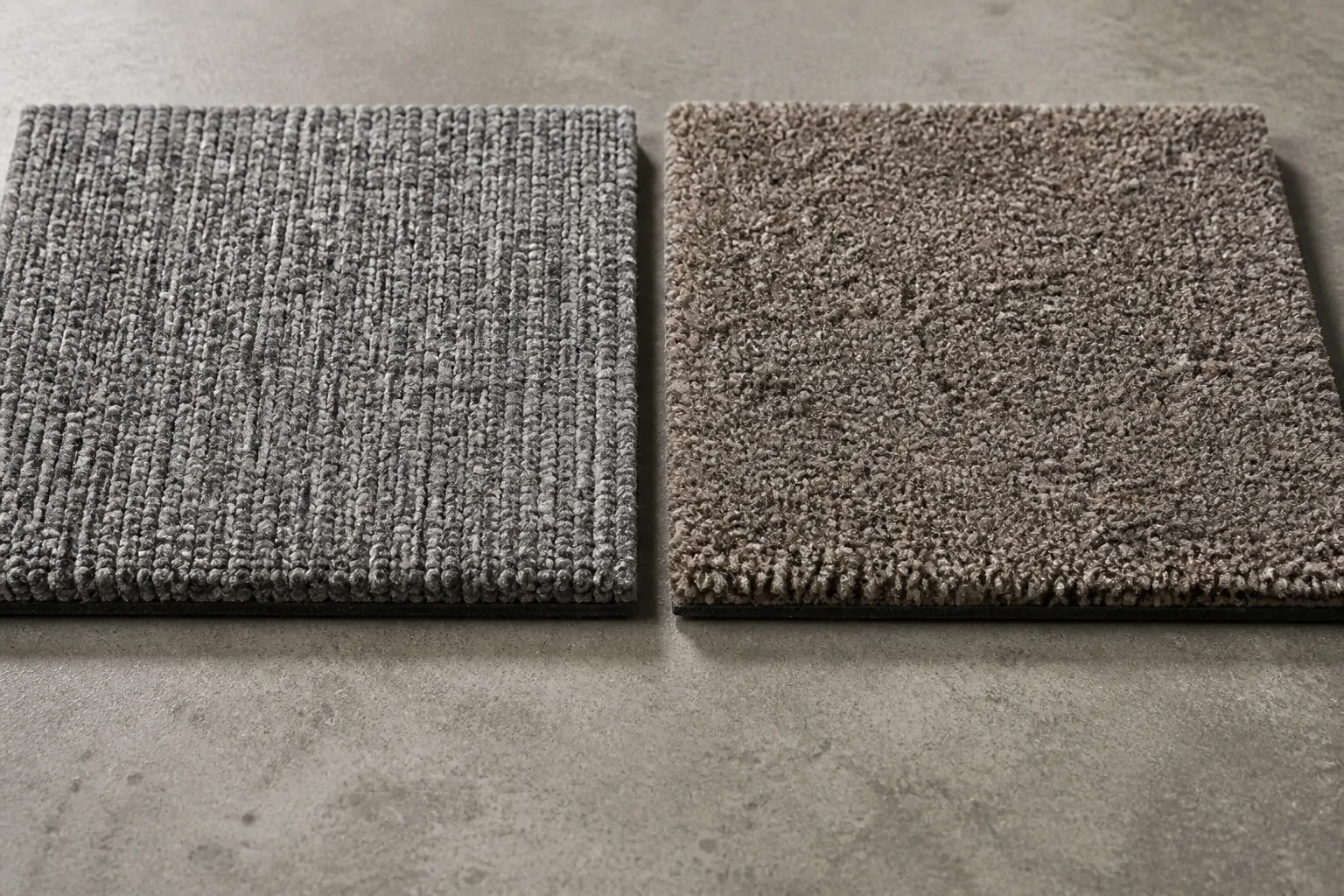
The following comparison is a starting point for commercial specification. It is not a substitute for product samples, construction data, or project-specific testing.
| Comparison | Nylon Carpet | Polypropylene Carpet |
|---|---|---|
| Fiber type | Synthetic nylon fiber | Synthetic polypropylene fiber, also called olefin |
| Resilience | Often considered for repeated compression and busy traffic | Depends strongly on pile construction and product design |
| Appearance retention | May be suitable where recovery and long-term appearance matter | Should be assessed with a sample under the expected traffic level |
| Stain resistance | Varies by fiber, dye method, finish, and spill type | Often considered for stain management, but is not automatically stainproof |
| Moisture resistance | Confirm the full product and backing specification | Can be considered where moisture exposure is a concern |
| Oil-based stains | Confirm cleaning guidance for the selected product | Confirm cleaning guidance because oil-based soil can behave differently |
| Color options | Broad options, including solution-dyed products | Broad options, including solution-dyed products |
| Cleaning | Follow the product maintenance instructions | Follow the product maintenance instructions |
| Initial product cost | Depends on specification and construction | Depends on specification and construction |
| High-traffic suitability | May be considered for corridors and active work areas | May be suitable for selected moderate-traffic areas |
| Common applications | Offices, hotels, schools, public interiors, and busy zones | Offices, support areas, selected commercial interiors, and modular projects |
| Confirm before ordering | Construction, density, backing, testing, cleaning, and samples | Construction, density, backing, testing, cleaning, and samples |
Nylon vs Polypropylene Carpet: Durability and High-Traffic Performance
Searches for nylon carpet for high traffic areas often reflect a real concern: will the surface keep its appearance after daily use? Nylon may be considered for main corridors, entrances, open offices, and areas with frequent furniture movement because fiber resilience can support recovery from compression.
Still, traffic performance cannot be judged by fiber name alone. Compare construction, surface weight, density, pile height, backing, installation quality, and the cleaning plan. Rolling traffic, chair casters, grit at entrances, and heavy furniture create different stresses. A lower-pile, well-constructed tile may be a better fit than a higher-pile product with a less suitable backing.
For either fiber, confirm expected traffic, maintenance frequency, spare tile planning, and replacement access. Keeping tiles from the same production lot can also help with future color matching.
Stain, Moisture, and Cleaning Performance
Water-based stains, food and beverage spills, entrance dirt, and oil-based soil do not behave in the same way. A commercial project should define likely contamination and cleaning frequency before selecting a fiber. Healthcare and education facilities may require more frequent cleaning, while food and beverage areas may need a response plan for repeated spills.
Polypropylene may be considered when moisture and stain management are important, but the product must still be evaluated by sample and documentation. Nylon can also perform well in commercial interiors when its construction and maintenance requirements match the application. In both cases, use the supplier’s approved cleaning method and confirm whether aggressive chemicals or heat could affect color or backing.
Solution-Dyed Nylon vs Solution-Dyed Polypropylene
In a solution dyed nylon carpet or solution-dyed polypropylene carpet, color is added during fiber production. This can support color consistency and may improve resistance to some forms of cleaning or fading. It does not make every solution-dyed product identical, and it does not remove the need to check test data, construction, and sample appearance.
Solution-dyed products can be useful when a project needs repeatable color selection or a planned replacement program. Ask whether replacement tiles can be matched, whether the sample represents the production specification, and which cleaning agents are approved. Color consistency should be considered alongside resilience, density, backing, and installation.
Appearance and Color Options
Design teams compare color clarity, pattern options, texture, and the ability to coordinate replacement tiles. Nylon and polypropylene can both support commercial design programs, including neutral palettes, subtle patterns, and custom commercial carpet options.
Do not approve a large order from a digital image alone. Review physical samples under the project’s lighting and compare them with wall finishes, furniture, and wayfinding requirements. Keep spare tiles from the same batch when a long-term replacement plan matters.
Price and Total Project Cost
Comparing only initial price per square meter can produce a misleading result. The total project cost may also include product specification, installation, waste allowance, cleaning, maintenance, replacement frequency, spare tiles, packaging, shipping, and project downtime.
A lower initial product cost may be useful for a cost-sensitive project, but the decision should account for expected traffic and replacement access. A higher-specification option may be considered where appearance retention, rolling traffic, or long-term maintenance planning carries more weight. Request a quotation based on the same construction and quantity so that the comparison is meaningful.
Which Material Is Better for Office Buildings?
Commercial nylon carpet or nylon carpet tiles may be considered for main corridors, open offices, busy work areas, meeting zones, and locations with frequent furniture movement. Polypropylene carpet tiles may be considered for lower-traffic offices, cost-sensitive projects, selected meeting or support areas, or applications where moisture and stain considerations are important.
Office buyers should compare traffic maps rather than specify one fiber for every room. Reception, circulation, workstations, and quiet rooms may have different requirements. A commercial carpet tiles program can make it easier to plan zones and future replacement.
Which Material Is Better for Education and Healthcare?
Education projects should assess student traffic, classroom cleaning, corridors, libraries, administrative offices, and replacement planning. Healthcare projects need careful review of cleaning requirements, stain management, wheeled traffic, acoustic comfort, indoor application, and available product documentation. No fiber should be described as automatically meeting a healthcare requirement without the relevant project review and supporting documentation.
For both sectors, the carpet tile backing, installation method, joints, cleaning plan, and spare stock can matter as much as fiber selection. Ask for samples and technical information before approval.
Which Material Is Better for Hotels?
Hotels often need different specifications in guest rooms, corridors, meeting rooms, conference areas, back-of-office spaces, public zones, and food and beverage areas. Nylon may be considered for busy public circulation, while polypropylene may be considered for selected areas where budget or moisture considerations have greater influence. The right answer may be a zone-by-zone combination rather than one material across the property.
Review appearance, cleaning access, furniture movement, guest expectations, replacement planning, and the effect of lighting on color. Samples should be evaluated in the intended application whenever possible.
Retail, Banks, and Public Buildings
Retail stores, banks, government buildings, conference centers, public service halls, waiting areas, and administrative offices combine traffic, maintenance, image, and budget requirements. Entrances and queues may experience more concentrated wear than private offices. Public projects may also require clearer documentation and a more controlled replacement plan.
Use a traffic map and maintenance brief to compare options. The commercial carpet product range should be reviewed by construction and application, not only by material name.
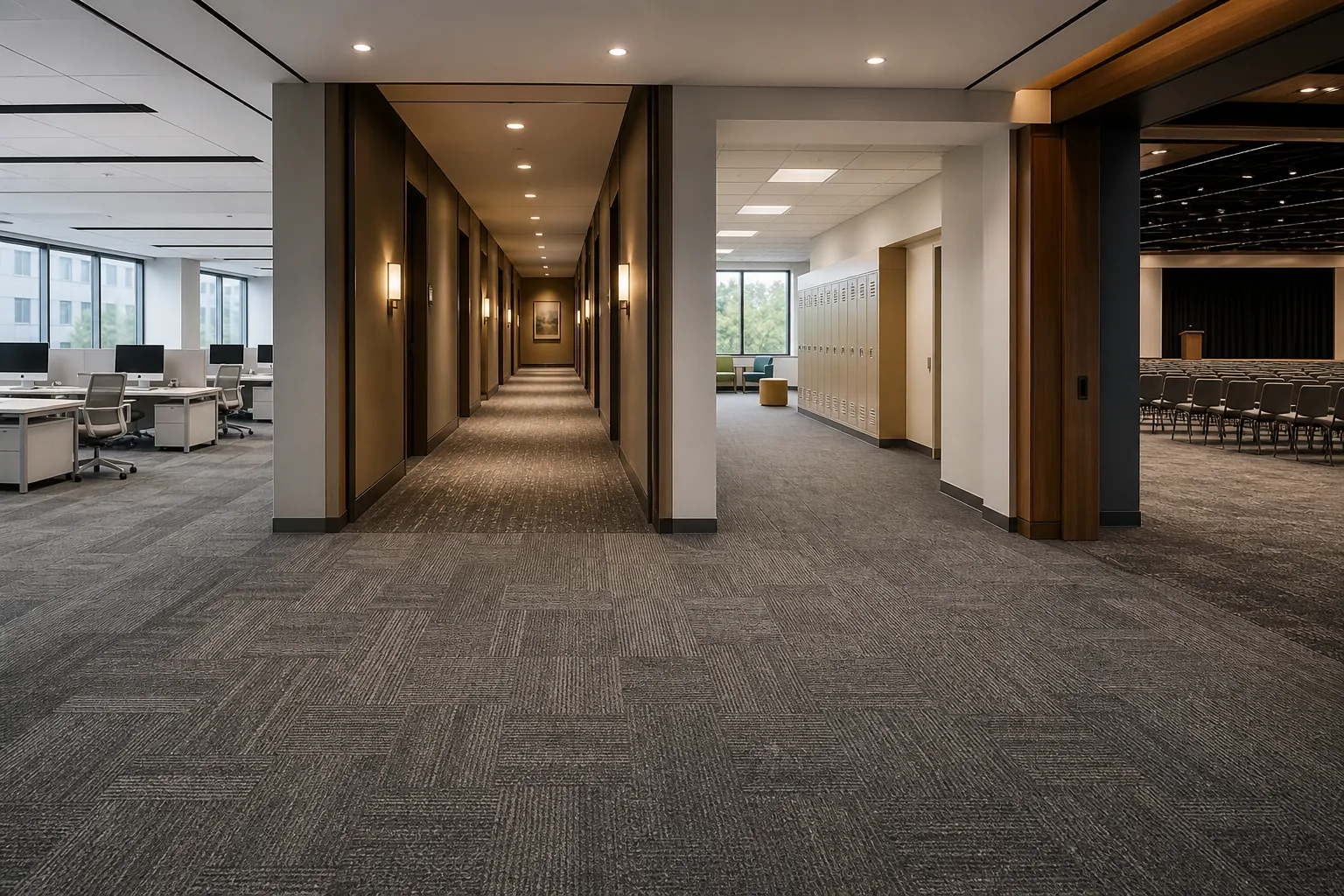
How to Choose Between Nylon and Polypropylene Carpet
Choose nylon for further review when the project has high foot traffic, busy corridors, frequent furniture movement, or a strong need for appearance retention. Choose polypropylene for further review when initial budget is a major consideration, traffic is moderate, moisture and stain management are important, or modular replacement is part of the plan.
These are screening points, not absolute conclusions. Compare the same product information for both options: fiber, dye method, construction, pile height, surface weight, density, backing, test reports, cleaning guidance, sample availability, and installation requirements. This is also where a carpet tile backing types review can prevent a fiber-only decision.
Questions to Ask a Carpet Tile Supplier
- Is the fiber nylon or polypropylene?
- Is the fiber solution-dyed?
- What carpet construction is used?
- What are the pile height and surface weight?
- What backing is used?
- Is the product suitable for the expected traffic level?
- What test reports are available?
- Are physical samples available?
- What is the MOQ?
- What is the production lead time?
- How should the carpet be cleaned and maintained?
- How is the product packed for export?
How Melozon Supports Commercial Carpet Buyers
Melozon can help B2B buyers compare nylon and polypropylene carpet tiles, communicate product specifications, review material and color options, and discuss standard or custom samples. Buyers can also use Melozon for OEM and ODM discussions, commercial carpet quotations, bulk production coordination, and export packing and shipping support.
For broader planning, review commercial carpet solutions and prepare the project details that affect selection. Send the project type, application area, expected traffic level, estimated quantity, preferred colors, destination, and required delivery date to request commercial carpet samples and a quote.
Frequently Asked Questions
Is nylon or polypropylene carpet better?
Neither is universally better in a nylon vs polypropylene carpet comparison. Nylon may be considered for higher traffic and appearance retention, while polypropylene may be considered for moderate traffic, budget, moisture, or stain-management priorities. Confirm the complete product specification.
What is the difference between nylon and polypropylene carpet?
They are different synthetic fibers with different resilience, cleaning, appearance, and application considerations. Construction, backing, dye method, and maintenance also affect performance.
Is polypropylene carpet the same as olefin carpet?
Yes. Olefin is a common name used for polypropylene fiber in carpet discussions.
Is nylon carpet suitable for high-traffic areas?
It may be suitable when the selected construction, density, backing, installation, and maintenance plan match the traffic. Fiber name alone is not enough.
Are nylon carpet tiles better for offices?
Nylon carpet tiles may be considered for busy offices, corridors, and areas with furniture movement. Compare them with the project’s traffic map and replacement plan.
Are polypropylene carpet tiles suitable for commercial projects?
They may be suitable for selected commercial applications, especially moderate-traffic or cost-sensitive areas. Review samples, construction, cleaning guidance, and documentation.
What is solution-dyed nylon carpet?
It is nylon carpet made with color added during fiber production. This can support color consistency, but product testing and the full specification still need to be confirmed.
What is solution-dyed polypropylene carpet?
It is polypropylene carpet made with color added during fiber production. It should still be assessed for construction, cleaning, fading, and application requirements.
Which carpet is better for hotels?
Hotels may use different materials in different zones. Compare public traffic, guest expectations, cleaning, food and beverage exposure, and replacement planning by area.
Which carpet is easier to clean?
Cleaning depends on fiber, construction, dye method, backing, soil type, and the approved cleaning process. Ask for product-specific maintenance instructions.
Compare Nylon and Polypropylene Carpet for Your Project
Send Melozon your project type, application area, expected traffic level, estimated quantity, preferred colors, destination, and required delivery date to request samples and a commercial quotation.